You may be experiencing pain, stiffness and swelling in your hands and wrists. Your Occupational Therapist may be able to provide advice and practical strategies to help you manage these symptoms.
For more information about the causes of hand and wrist pain, and useful advice on how to manage your symptoms, please see Arthritis UK – Hand and wrist pain and Arthritis UK – Managing arthritis pain.
Compression Gloves
Compression gloves may help to reduce pain, stiffness and swelling in your hands. They can be worn during the day or overnight in bed, provided they are comfortable and do not restrict your circulation. If wearing them during the day, non-slip gloves may be helpful for carrying out everyday activities.
Contrast Bathing
Alternating between warm and cold water may help to reduce stiffness, swelling and pain in your hands. Your Occupational Therapist can advise you on whether this is suitable for you and how to do it safely.
For further information and support with managing pain, please visit Pain Association Scotland.
Treatment Options
1. Pain and Swelling Management
2. Splinting
Your Occupational Therapist may recommend a splint to help maintain the position of your hand or wrist. Splints can help reduce strain and pain when carrying out everyday activities and tasks.
There are two main types of splint:
Resting splints – used to support and rest the joints of the hand and wrist.
Functional splints – used to support the hand and wrist while carrying out everyday activities and tasks.
Your Occupational Therapist will advise you on the most appropriate type of splint for your needs and how and when to use it.
Further information about splints can be found at Arthritis UK
There are two main types of splint:
Resting splints – used to support and rest the joints of the hand and wrist.
Functional splints – used to support the hand and wrist while carrying out everyday activities and tasks.
Your Occupational Therapist will advise you on the most appropriate type of splint for your needs and how and when to use it.
Further information about splints can be found at Arthritis UK
3. Hand and thumb exercises
Your Occupational Therapist may provide you with a personalised hand exercise programme to help maintain or improve the mobility and strength of your joints.
If you have any questions or concerns about your exercises, please contact your Occupational Therapist.
For further information and exercise advice, please see:
Arthritis UK: Exercises for the fingers, hands and wrists
NHS inform: Exercises for the wrist, hand and fingers
If you have any questions or concerns about your exercises, please contact your Occupational Therapist.
For further information and exercise advice, please see:
Arthritis UK: Exercises for the fingers, hands and wrists
NHS inform: Exercises for the wrist, hand and fingers
4. Joint protection advice
You may be experiencing difficulties carrying out your usual activities. An Occupational Therapist can suggest alternative ways of completing activities that may be easier or less painful.
They can also provide advice and recommend equipment or aids that you may wish to purchase to help you maintain your independence with self-care, work and leisure activities.
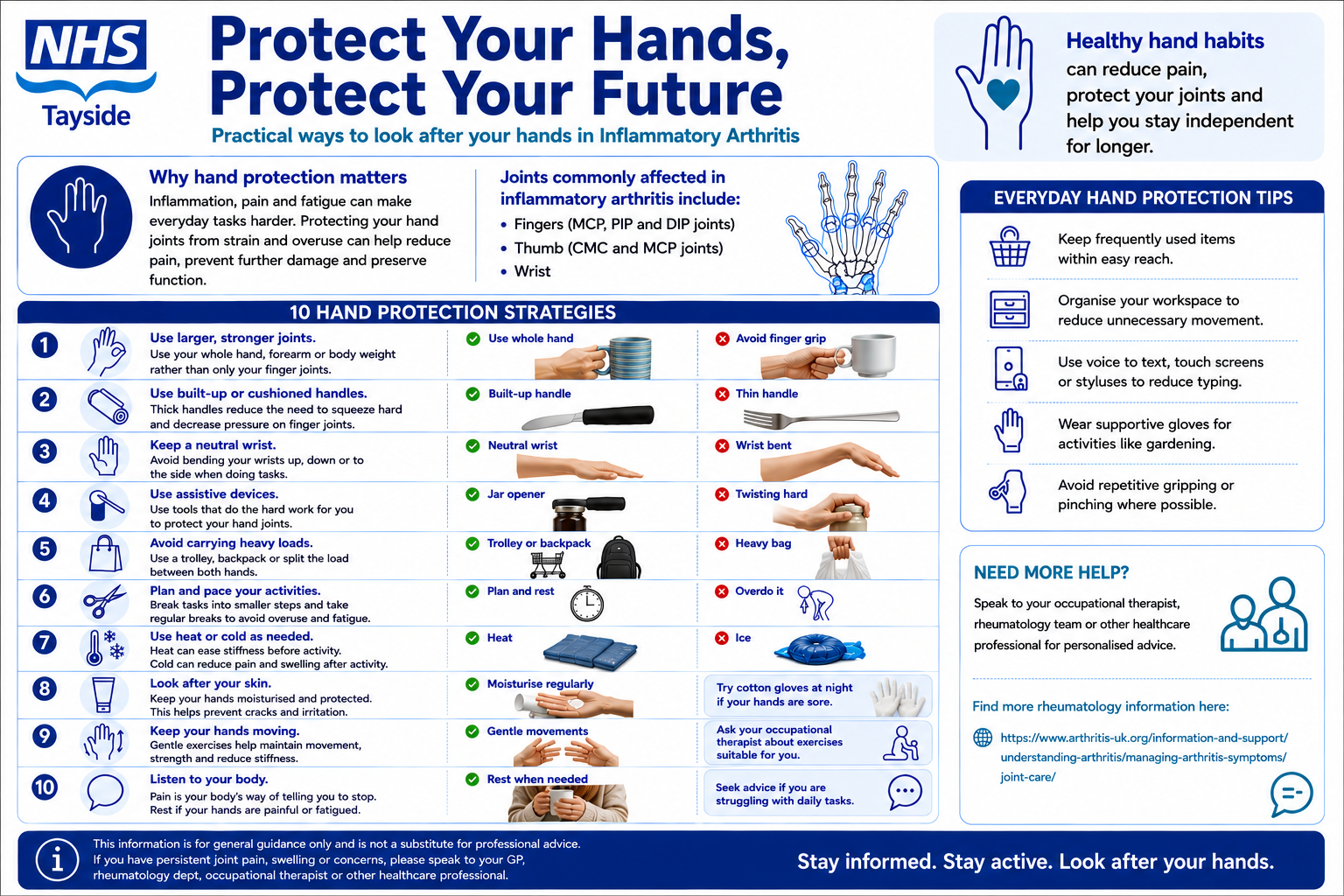
Click image for a guide to Joint Protection
An Occupational Therapist can advise you on techniques to help reduce aches, pain and strain on your joints, making everyday activities easier and more comfortable.
Further helpful information can be found at the following links:
Joint Care advice from Arthritis UK
Aids and adaptations information from Arthritis UK
NHS Inform advice on how to protect your joints
They can also provide advice and recommend equipment or aids that you may wish to purchase to help you maintain your independence with self-care, work and leisure activities.
Click image for a guide to Joint Protection
An Occupational Therapist can advise you on techniques to help reduce aches, pain and strain on your joints, making everyday activities easier and more comfortable.
Further helpful information can be found at the following links:
Joint Care advice from Arthritis UK
Aids and adaptations information from Arthritis UK
NHS Inform advice on how to protect your joints
5. Fatigue management
Fatigue is very common in people with Inflammatory Arthritis and can have a significant impact on your daily life. Unlike tiredness, fatigue is not always relieved by rest or sleep.
Fatigue can affect you physically, but it can also impact your motivation, concentration, memory and emotions. You may find that you need to save your energy for essential tasks, meaning you have less energy for the activities you enjoy.
Your Occupational Therapist can help you explore strategies to manage your fatigue, conserve your energy and make the most of your day.
Further helpful information can be found at the following links:
Managing fatigue - Arthritis UK
Food and Nutrition - NHS Inform
Fatigue can affect you physically, but it can also impact your motivation, concentration, memory and emotions. You may find that you need to save your energy for essential tasks, meaning you have less energy for the activities you enjoy.
Your Occupational Therapist can help you explore strategies to manage your fatigue, conserve your energy and make the most of your day.
Further helpful information can be found at the following links:
Managing fatigue - Arthritis UK
Food and Nutrition - NHS Inform
5. Sleep
Getting enough good-quality sleep can help you manage a long-term health condition such as Inflammatory Arthritis. However, pain and other symptoms associated with arthritis can make it difficult to get a good night’s sleep.
There are some positive steps you can take to help improve your sleep and develop healthy sleep habits. Further information and support can be found at the following links:
Sleep - Arthritis UK
Sleep hygiene - NHS Inform
Sleepio - NHS-supported digital programme to help improve sleep
There are some positive steps you can take to help improve your sleep and develop healthy sleep habits. Further information and support can be found at the following links:
Sleep - Arthritis UK
Sleep hygiene - NHS Inform
Sleepio - NHS-supported digital programme to help improve sleep
6. Work support and guidance
The Occupational Therapist can support you to manage your symptoms at work and signpost you to services which can help, e.g. work station set-up, posture, reasonable adjustments that your employer could consider to support you.
Further useful information can be found at the links below:
Work and Arthritis - Arthritis UK
Work - National Rheumatoid Arthritis Society (NRAS)
Access to Work - GOV.UK
Further useful information can be found at the links below:
Work and Arthritis - Arthritis UK
Work - National Rheumatoid Arthritis Society (NRAS)
Access to Work - GOV.UK
7. Emotional and wellbeing support
Receiving a diagnosis of Inflammatory Arthritis can be difficult to process and may take time to adjust to. Your Occupational Therapist can offer support as you adapt to your diagnosis and can signpost you to appropriate services for additional support, such as:
8. Referrals to other services
You may also experience other difficulties related to your condition. Your Occupational Therapist may refer you to other members of the AHP Multidisciplinary Team, such as a Physiotherapist or Podiatrist, who can provide further assessment and support.
You may also be referred to a Community Occupational Therapist, who can visit you at home to assess your needs and provide advice on your home environment, including ways to help you manage everyday activities safely and independently.
You may also be referred to a Community Occupational Therapist, who can visit you at home to assess your needs and provide advice on your home environment, including ways to help you manage everyday activities safely and independently.