The exercises below are meant as general examples often used in physiotherapy for people with coordination difficulties. They are some basic ideas that can hep you to self manage your condition.
Only try exercises that feel safe for your abilities. Always stand beside a support (such as a kitchen worktop or rail) and use as required to maintain your safety. If you are unsure, discuss these exercises with your physiotherapist or a health care professional before starting.
Exercises for Coordination & Balance
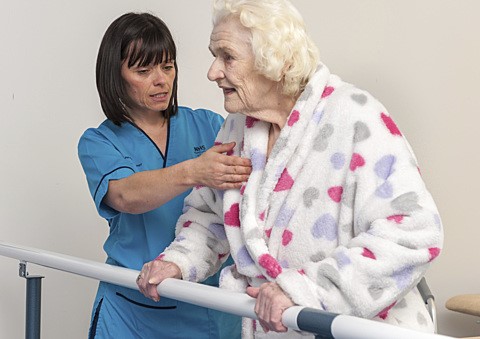
When suffering from issues regarding ataxia (or reduced coordination), maintaining good strength, endurance and practicing movements and exercises that require coordinated movements can help to both maintain your abilities as long as possible, and in some cases improve your movement.
Maintain your safety
General exercise advice
As you are working on balance and coordination in these exercises, focus on quality of movement over how many repetitions you can do. Practice little and often and allow rests between exercises to avoid becoming fatigued, which would make your quality of movement worse.
Coordination exercises
These exercises focus on slow, controlled movements using your vision to help guide the coordinated pattern. Some examples include:
- In lying or sitting, slowly slide one heel up and down the front of the opposite leg, use your shin bone as a line to trace along, keeping the movement as accurate as possible.
- Sitting exercise: Place a few markers on the floor around your foot. Move your foot between the targets in a slow and coordinated manner.
- In standing with support as required. Tap your foot onto 4-5 markers on the floor in a random order
Upper limb (arm) Coordination
Depending on the condition causing ataxia, it can also affect the upper limbs, making basic tasks more challenging and more fatiguing. To work upper limb coordination try placing markers on a table in front of you, or having markers placed on a wall. Reach to touch these markers in a random order, much like the lower limb coordination exercises. Other variations include moving objects of different weight and sizes between markers, focusing on the control of the movement, and performing alternating hand movements slowly and rhythmically.
Static balance exercises
Before working on balance that incorporates movement, it's important to work on stationary balance too. Holding onto a supportive surface, stand with your feet shoulder width apart. If you can stand there safely, can you remove one hand, and if safe, both hands? If this feels easy. Place your feet together so the inside of your feet are touching together, now try progressing your hands support as safe to do so, and focus your eyes on a fixed point to help with orientation.
Dynamic Balance Exercises
If you can safely perform static balance exercises, you may be ready to progress to dynamic balance exercises. These incorporate a bit of movement to challenge the balance further. If it's safe to do so, try:
- Stepping forwards, backwards or side to side in a controlled manner.
- Sway your hips from side to side transferring your weight from one leg to the other while keeping the feet planted.
- Walk along and incorporate changes, trying stopping and starting, or changing direction. All while maintaining your safety. Try walking along aiming your feet for certain tiles or marks on the floor that would be where your next step is meant to go.
- For a harder challenge, try walking heel-toe beside your kitchen unit for support, turn and repeat the same back to the start. Focus on controlled movement, keeping in a straight lin with your feet as much as possible.
Eye Coordination
In certain ataxic conditions, the coordination of your eyes may be impacted, which can cause issues with dizziness and decrease your balance. Try focusing your eyes on a target while you gently turn your head from side-to-side, maintaining your focus on the target throughout. Progress this slowly and in a comfortable manner. Stop if symptoms increase.